When almshouse charities face major repair costs or seek to expand provision for people in housing need, financial support can make the difference between decline and long-term sustainability. As part of its member services, The Almshouse Association provides grants and interest-free loans to help charities maintain, improve and develop their housing for residents.
This case study highlights how Robert Cocks Almshouse Charity was able to undertake a major programme of roof restoration and conservation works with the support of a £50,000 loan from The Almshouse Association.
The project involved the complete stripping and re-slating of roofs dating from 1860, extensive chimney repairs, replacement leadwork and rainwater goods, and the restoration of decorative ridge tiles and finials. As a prominent listed Victorian almshouse within the Old Buckenham Conservation Area, the works required careful planning, specialist contractors and close collaboration with conservation officers to preserve the character and historic significance of the buildings.
For the trustees, the challenge was not only technical but financial. Rising construction costs, heritage requirements and the risk of hidden structural issues all contributed to a complex and costly project. However, with the assistance of the Association’s loan scheme, the Charity was able to proceed with confidence and safeguard the almshouses for future generations.
The completed restoration ensures that the almshouses can continue providing affordable and well-maintained homes for local people in housing need, while protecting an important part of the village’s historic environment.
CASE STUDY
Background
There is little information concerning the Robert Cocks Almshouse prior to the post war period and judging by the works that were then carried out, today’s trustees believe it is safe to assume that little indeed was done to alter the properties from the original.
In 1954, from old plans found in files, bathrooms and foul drainage were added. Before this work, it appears from the plans that the amenities available consisted of a drinking water well and pump, a rainwater tank and pump (presumably for clothes/washing purposes), commonly called a soft water tank in Victorian construction.
Each property had a washhouse, containing a coal bunker and a stove with a separate externally accessed privy. The latter, following various public health legislation, would have been emptied by the Rural District Council. The improvement works in 1954 resulted in the washhouse becoming the kitchen, the privy becoming the coal bunker and a newly constructed bathroom added. The septic tank foul drainage was latterly connected to mains drainage when that arrived in the village.
Due, no doubt, to post-war austerity, the bathrooms were very simply constructed, comprising corrugated asbestos cement roofing, a single plasterboard ceiling and an external wall comprising a single half brick. We can only imagine the internal temperature in winter! At the same time, brick sheds were built to replace various structures displaced by the new bathrooms. These sheds still remain but, have recently had dangerous asbestos cement roofing replaced.
Various heating systems appear to have been installed. Originally, Cottager Stoves were installed in both the living and bedroom, and it is assumed the living room stove was the source of cooking. Over the last few years, the trustees have replaced the previous unreliable heating systems with programmable electric radiators.
And so, the above-described kitchens and bathrooms largely remained until 2015 when a major programme of modernisation was initiated, which is still ongoing today…
Works completed in the last 10 years includes:
- replacing heating and hot water systems,
- replacing all kitchen and bathroom fittings,
- replacing kitchen and bathroom windows,
- redecoration, internally and externally,
- renewing carpets and vinyl floorings,
- extending and renewing electrical systems,
- fitting fire detection and firefighting equipment,
- replacing incoming water mains,
- rationalising and renewing surface water drainage,
- replacing bathroom roofs and insulating bathroom walls,
- replacing asbestos cement shed roofing,
- upgrading roof insulation.
And finally, the Charity’s current major project of completely stripping the roofs, repairing and repointing the chimneys, replacing all leadwork and rainwater goods and re-slating with original Welsh Slate and replacing the majority of the decorative ridge tiles and finials.
The Need
Put very simply, the roofs in 2025 were as constructed in 1860, it is a measure of the quality of Victorian workmanship that they had lasted so long. But the slippage of slates due to nail sickness was becoming a major drain on the Charity’s resources. The roof could not be left exposed to the elements without addressing each missing slate.
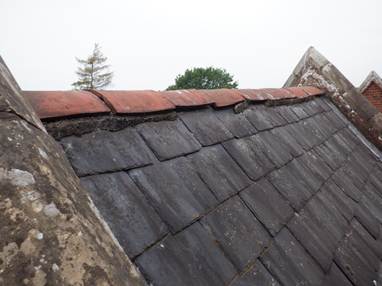 Ridge in poor condition
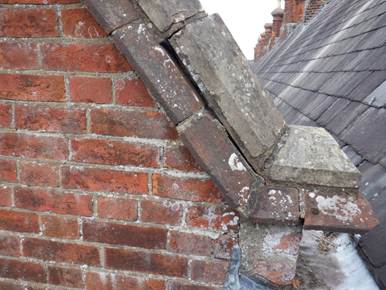 Loose coping stones
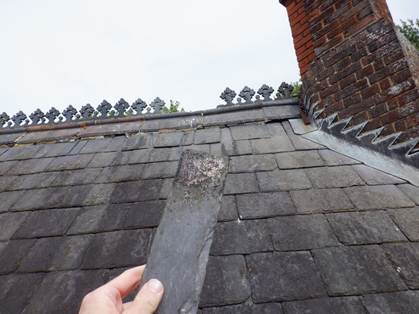 Slipped slates and damaged finials
Due to health and safety issues, it became no longer a simple job of replacing a slate. Thus, approximately five years ago, it was decided that the trustees had to plan for the major work now being carried out. Fortunately, they had both some financial resources and construction expertise to carry this forward. Due to the listed status of the property and its prominence in the Old Buckenham Conservation Area, the local authority Listed Building Officer was involved at all times and necessary consents were obtained.
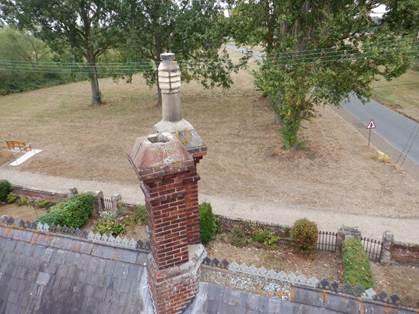 Chimney stack with non-original, unsympathetic pot, some missing.
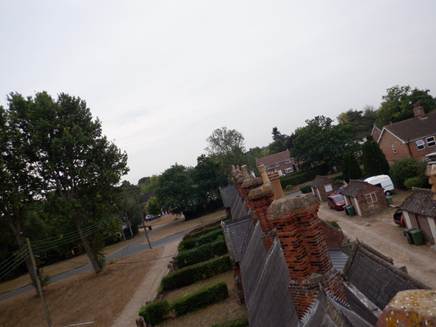 All ten chimney stacks for repair and installation of sympathetic pots.
The Process
Once the decision had been taken to move forward and engage seriously with the project, the trustees needed a realistic assessment of the likely cost. They had the benefit of a retired architect trustee with experience in listed building work, together with a recent quinquennial survey which highlighted visible defects and issues. Whilst the internal roof structure was accessible and appeared structurally sound, an ornate Victorian design such as theirs would inevitably contain many hidden areas with potential problems that would only become apparent once work had commenced.
As a result, when drawing up the specification and works schedule, the trustees had to include significant provisional and contingency sums to allow for unforeseen issues. Although not yet in a position to proceed with the project, they decided to seek competitive tenders as the only realistic way to establish an accurate budget.
In early 2021, tenders were sought from four specialist contractors, of which three submitted responses. These were carefully analysed due to significant variations in inclusions and omissions. A like-for-like consensus was eventually reached, producing a total VAT-inclusive figure of £127,068. This included approximately £16,000 for provisional and contingency items.
The matter was then put to one side while a broader review of finances was undertaken. In October 2023, updated costings were obtained, as the building industry had experienced significant inflation resulting from the combined effects of Covid and the war in Ukraine. This produced a revised projected maximum spend of £160,712.
After careful consideration of both current finances and future financial planning, it was agreed to seek a loan of £50,000 from The Almshouse Association. This was approved in 2024, and the main contractor, Aspect Group Services, was appointed with a projected final contract figure of £164,000 including VAT, based on January 2025 prices, with works scheduled to commence in June 2025.
A local firm of Chartered Surveyors, North & Hawkins, was appointed to provide contract management services.
The Works
Scaffolding was erected during the last week of June 2025, and work properly commenced at the beginning of July.
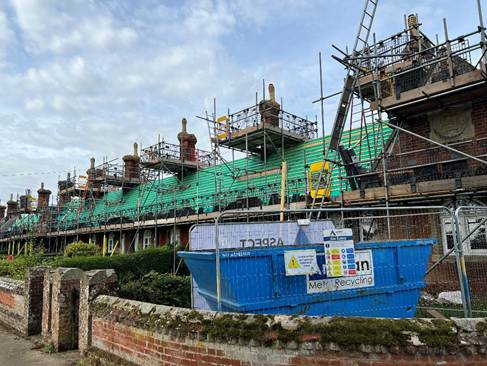 Building scaffolding and new felt and batons
The initial phase, involving the stripping of the existing slates and leadwork, was always expected to be the stage at which any major unforeseen problems would emerge, particularly in relation to structural timberwork at the valleys and the close boarding beneath the slates that covered the entire roof.
In reality, only minor timber repairs to the close boarding proved necessary, and the original Victorian leadwork had successfully protected the structure from the elements for more than 160 years.
Roofing Construction Challenges
One unexpected discovery was that the slates had originally been nailed directly onto the boarding without the use of tiling battens. Whilst unusual in England, this practice is apparently not uncommon in Scotland.
Modern roofing standards, however, require the installation of battens and counter-battens. Combined with the already shallow abutments at the brick parapet gables, this meant that the ridge line would need to be raised by approximately 100mm. Although this had been anticipated and Listed Building Consent had already been obtained, the practical implications at the brick parapet abutments proved more complicated than expected.
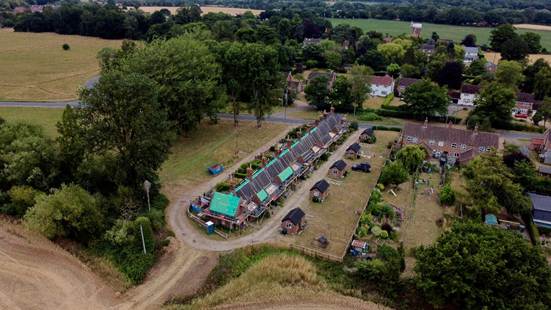 Aerial view of back of property and works in progress, taken by a drone (S. Hammond)
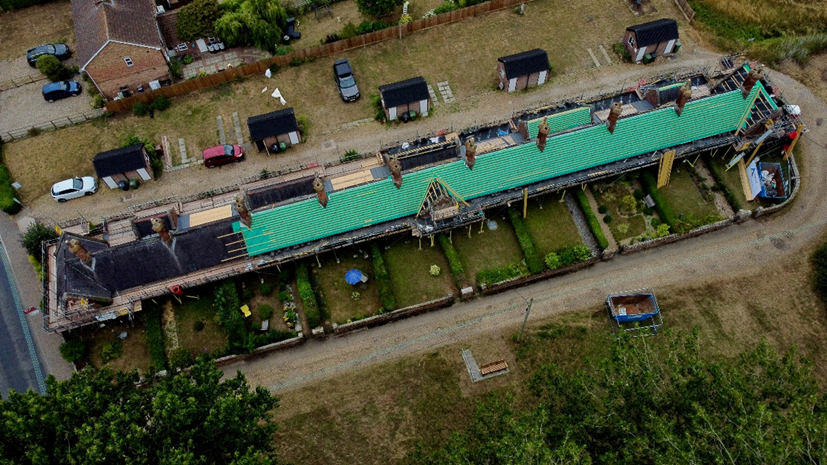 Aerial view of front of property and works in progress, taken by drone (S.Hammond)
Raising the brick parapets by approximately 150mm would have required extensive alteration and replacement brickwork, with consequential impact on the incorporated stone detailing. Fortunately, the contractor identified an alternative solution through the use of lead secret gutters at the principal abutments, rather than the more conventional lead flashings. This approach proved both visually unobtrusive and highly successful.
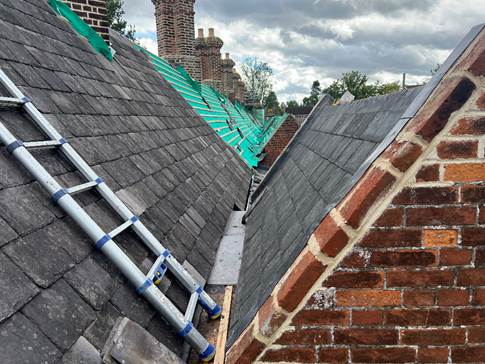 Works in progress between main roof and kitchen roofs
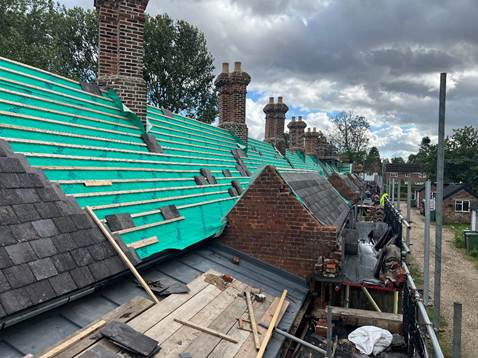 Work at the rear of the property, with slates and chimney re-pointing complete. Protection of the bathroom rubber roofing.
Ridge tiles and decorative features
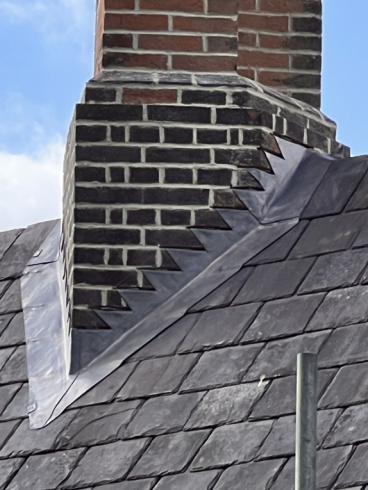 One of ten newly repointed chimney stacks and lead work, with slates relaid (October 2025). The new ornate finials were added after this photo was taken, in November 2025.
The most significant issue, and the principal cause of increased cost, arose from the existing ridge tiles and the brick copings and detailing to the rear parapets that required raising.
The ridge tiles themselves are an important decorative feature, incorporating a slotted top into which ornate finials are fitted.
Upon close inspection and removal, it became clear that many had previously been poorly repaired and could not realistically be reused successfully.
It was eventually possible to source purpose-made replacements, although at considerable cost. Nevertheless, the ridges and chimneys are widely regarded as the most distinctive architectural features of the building and therefore could not be ignored or subjected to an inferior repair.
The necessity to order substantially more replacement ridge tiles than originally anticipated resulted in delays to the overall completion programme while manufacture was undertaken.
Completion of the project
The contract was finally completed during the week commencing 23 November 2025. A snagging inspection took place on Friday 5 December 2025, with very few items requiring rectification, and practical completion was deemed to have occurred on that date.
The final account figure is expected to be approximately £175,000 including VAT.
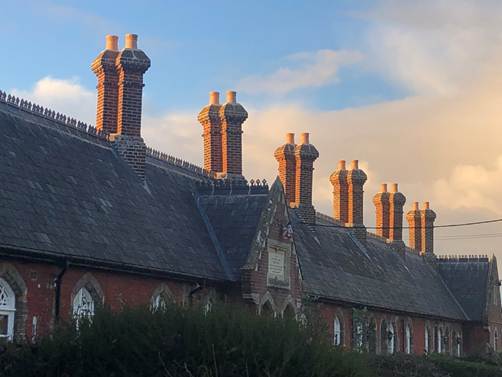 Completion of roof and chimney works, with sympathetic pots

The loan from The Almshouse Association enabled the Charity to complete the restoration of their almshouses and continue their provision of affordable housing in the local area for people in housing need.
We would like to thank all the people and organisations who so kindly donate to The Almshouse Association and leave gifts in their Wills. Without their generosity, we would not be in a position to help support almshouse charities with their renovations and new builds.
The Almshouse Association awards loans and grants to our member charities every year. In 2025, £1,198,500 was approved in new loans and grants totalled £50,000. Charities pay no interest on the loans, just a small administration fee. As they make repayments on the loans over a ten-year period, the Association can continue to offer loans to charities year after year, meaning that your donations continue to support almshouses and their residents in perpetuity.
If you are interested in making a donation to The Almshouse Association or leaving a gift in your Will, please do visit our Support Us pages here.
posted May 2026