CASE STUDY: Rubgy’s St John’s Street almshouses roof replacement
Every almshouse charity faces moments when essential investment cannot be delayed. Whether responding to ageing buildings, unexpected structural problems or financial setbacks, securing the right support can be the difference between simply managing and safeguarding homes for generations to come.
As part of its commitment to members, The Almshouse Association provides grants and interest-free loans to help charities carry out vital repairs, improvements and development projects that might otherwise be beyond their reach.
This case study tells the story of the Butlin and Elborow Housing Trust in Rugby, whose trustees overcame significant financial challenges, unforeseen construction issues and the lasting impact of fraud to complete a major roof replacement programme. With careful financial management, determination and the support of an interest-free loan from The Almshouse Association, they have secured the future of six historic almshouses, ensuring their residents can continue to enjoy safe, comfortable homes for many years to come.
Background
The Butlin and Elborow Housing Trust (the Trust) manage two groups of almshouses in Rugby.
The first consists of six almshouses in Stephen Street. Originally built in 1860, they were replaced with the current properties in 1905. Each home provides single-storey accommodation with a lounge/kitchen, wet room and bedroom.
The second group comprises six almshouses in St John’s Street, built in 1885. These homes have a lounge, kitchen and bathroom on the ground floor, with a bedroom upstairs.
Historically, one group of almshouses was managed by St Andrew’s Church and the other by St Matthew’s Church. The two churches decided to link the two almshouses together to form the Butlin and Elborow Housing Trust.
The need for the project
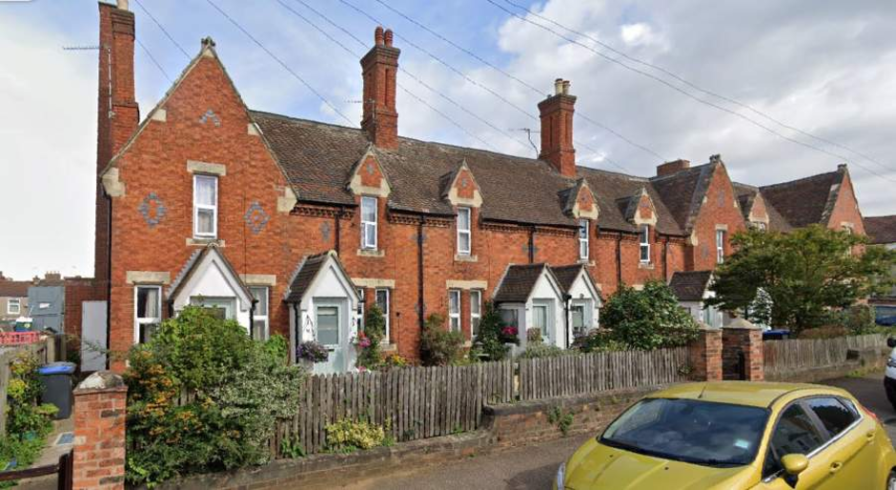 Before repairs
For many years, the roof at the St John’s Street almshouses had received only limited maintenance. As a result, coping tiles had become loose, several roof tiles had slipped or cracked, and the roof had deteriorated to the point where a full replacement was necessary.
The Trust faced an additional challenge. A former trustee had dishonestly misappropriated the Trust’s financial reserves over a period of years, leaving the Trust in a difficult financial position. Although we had already taken out loans to stabilise our finances, replacing the roof represented a significant additional expense.
In 2024, the trustees began seeking quotations for the work and appointed Hall & Co., a reputable Rugby-based contractor. At the same time, we sought grant funding to help finance the project. Despite approaching a number of funders over several months, the only grant secured was £3,000 from the Baron Davenport Trust.
Carrying out the works
Because of existing commitments, Hall & Co. were unable to begin work until November 2025, despite an original planned start date of September.
Once work commenced, a number of unforeseen issues emerged.
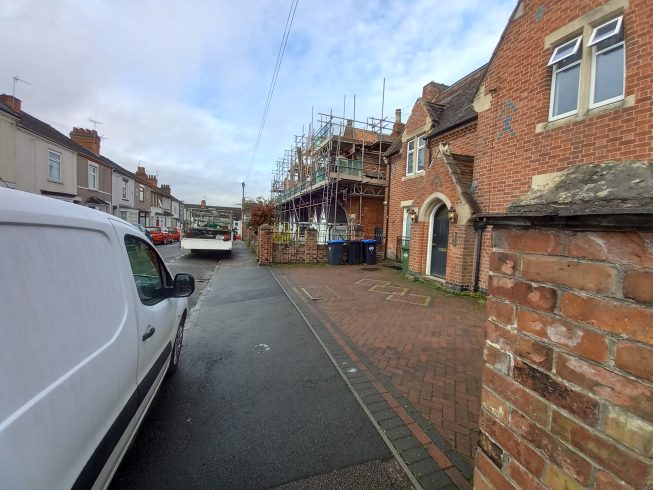 During repairs
The first concerned the tall brick chimneys. Although no longer in use since the installation of modern central heating, they were found to be leaning and structurally unsafe. As they were not protected by any preservation order, the trustees decided to take them down as this was the safest and most cost-effective option rather than rebuilding them.
Further inspection revealed that several structural timbers within the roof had rotted and required replacement.
Another challenge arose when matching replacement roof tiles proved impossible. New tiles had to be sourced at greater cost than anticipated. To preserve the appearance of the building and control costs wherever possible, the builders carefully salvaged many of the original tiles. New tiles were used on the front elevation facing the road, while reclaimed tiles were reused on the rear. The finished result blends well with the character of the building.
The project was also delayed by exceptionally poor weather throughout November and December, which slowed progress considerably. Throughout this period, the residents were extremely patient despite having scaffolding around their homes for several weeks.
An unexpected requirement
During the project, the local authority’s building surveyor identified that there were no firebreaks between the roof spaces of the individual dwellings.
This work had to be carried out before the project could be completed, adding an unforeseen but essential element to the contract and increasing the overall cost.
Funding the project
The total cost of the project was approximately £81,000. Our original loan application to The Almshouse Association was for £70,000 over ten years. However, by carefully managing our finances and contributing significantly from our own reserves, we ultimately only needed to borrow £40,000 which we will repay over seven years.
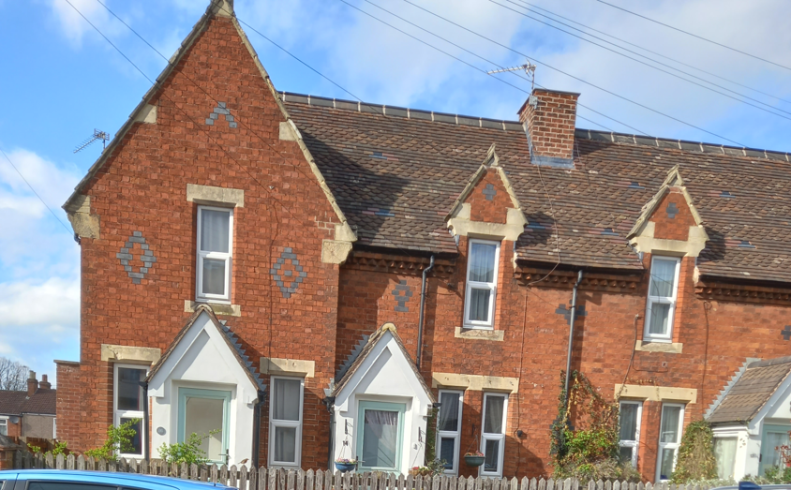 After repairs
We are particularly proud that the Trust was able to fund almost half of the overall project cost itself, especially given the financial difficulties we had faced following the fraudulent loss of our reserves.
Without the support of The Almshouse Association, this essential project would simply not have been possible, and the condition of the roof would have continued to deteriorate.
Resident response
When the scaffolding was finally removed, the residents were delighted with the finished result. Several expressed their appreciation, with one resident commenting:
“It’s wonderful to come out of my front door without having to look up and wonder whether a roof tile might fall on my head.”
Their comments reinforced the importance of investing in safe, secure and well-maintained homes.
Acknowledgements
The trustees would like to express their thanks to The Almshouse Association for its financial support and encouragement throughout this project. Their assistance enabled us to complete essential works that will protect these historic almshouses and provide safe homes for our residents for many years to come.
Case Study by Roger Evans – Chair of Trustees
The Almshouse Association was delighted to support this project through its grants and loans programme, helping to ensure that another historic almshouse can continue its long tradition of providing homes and communities for those who need them most.
We would like to thank all the people and organisations who so kindly donate to The Almshouse Association and leave gifts in their Wills. Without their generosity, we would not be in a position to help support almshouse charities with their renovations and new builds.
The Almshouse Association awards loans and grants to our member charities every year. In 2025, £1,198,500 was approved in new loans and grants totalled £50,000. Charities pay no interest on the loans, just a small administration fee. As they make repayments on the loans over a ten-year period, the Association can continue to offer loans to charities year after year, meaning that your donations continue to support almshouses and their residents in perpetuity.
If you are interested in making a donation to The Almshouse Association or leaving a gift in your Will, please do visit our Support Us pages here.
posted 9 July 2026osted August 2026