Our pizzas are worth more than care for elderly people …. we all agree? Don’t we?
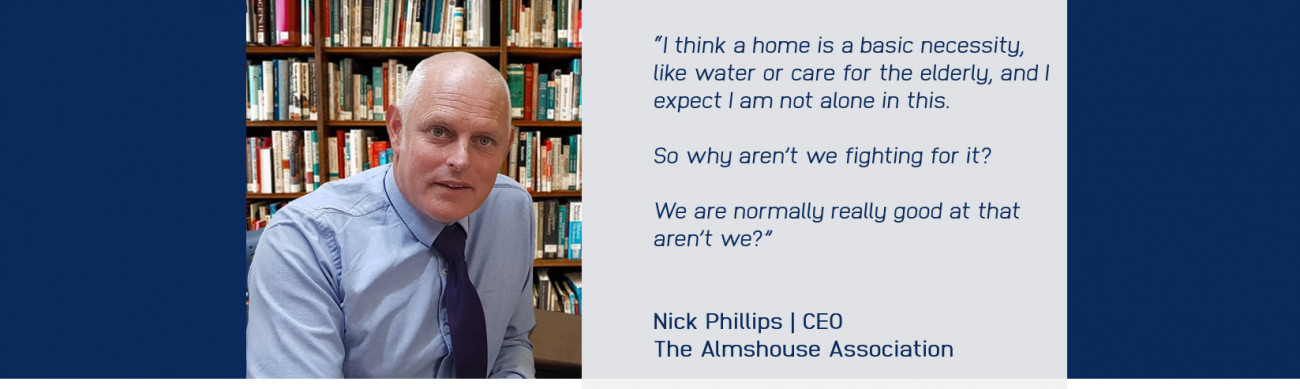
I think a home is a basic necessity, like water or care for the elderly, and I expect I am not alone in this. So why aren’t we fighting for it? We are normally really good at that aren’t we? It was not so long ago that we supported en masse Uber drivers, pizza delivery riders and sports shop workers because of their appalling pay and conditions.
This was going to be a long blog setting out the various shared elements of the two great frustrations where the same people often find themselves overlooked and/or undervalued. However, there just seems so little point. It is like pointing out that football players are paid more than nurses and much as we love to see a kick around we all know we definitely need one more than the other. This is of course, the stuff of three in the morning teenage debate. It is what it is – get over it!
When I read about the uproar from investment companies backing out of a well-known pizza delivery company because of their bad pay and conditions …. it brought me up sharp again, (Maybe it was three in the morning!) but people were taking notice! Bad pay and conditions for our pizza delivery riders – things must change, it’s not fair! Quite right! But I sigh inwardly when I talked to a close friend who was a carer who expressed how he was only paid for between 30 and 45 minutes work with clients and often has unpaid one hour drive between clients. He then needs to spend at least 75 minutes with some clients to help dress wounds, make a cup of tea or clean them. These were people not pizzas. He eventually had to stop being a carer as it was costing too much of his own student money to support the job.
What does this have to do with affordable housing? It is my view that good housing is linked to a reduced need for social care. We know loneliness and poor housing can lead to mental and even physical illness, depression and the need for medication. If we recognise that as a bare minimum people need a good quality, warm, safe home, a friend and neighbour we could reduce the cost to the health service.
We must start looking at integrating health, social care and housing, closely intertwined areas which all benefit each other. When all three elements work together effectively, the whole system can work better and provide significant cost savings through reduced attendance at A&E and reductions in loneliness and its associated consequences.
Small-scale charitable community homes, like almshouses, can save the health service a fortune and perhaps with that saving the Government could afford to pay our carers at least as much as the guy who brings us our pizza. Bon appetite!
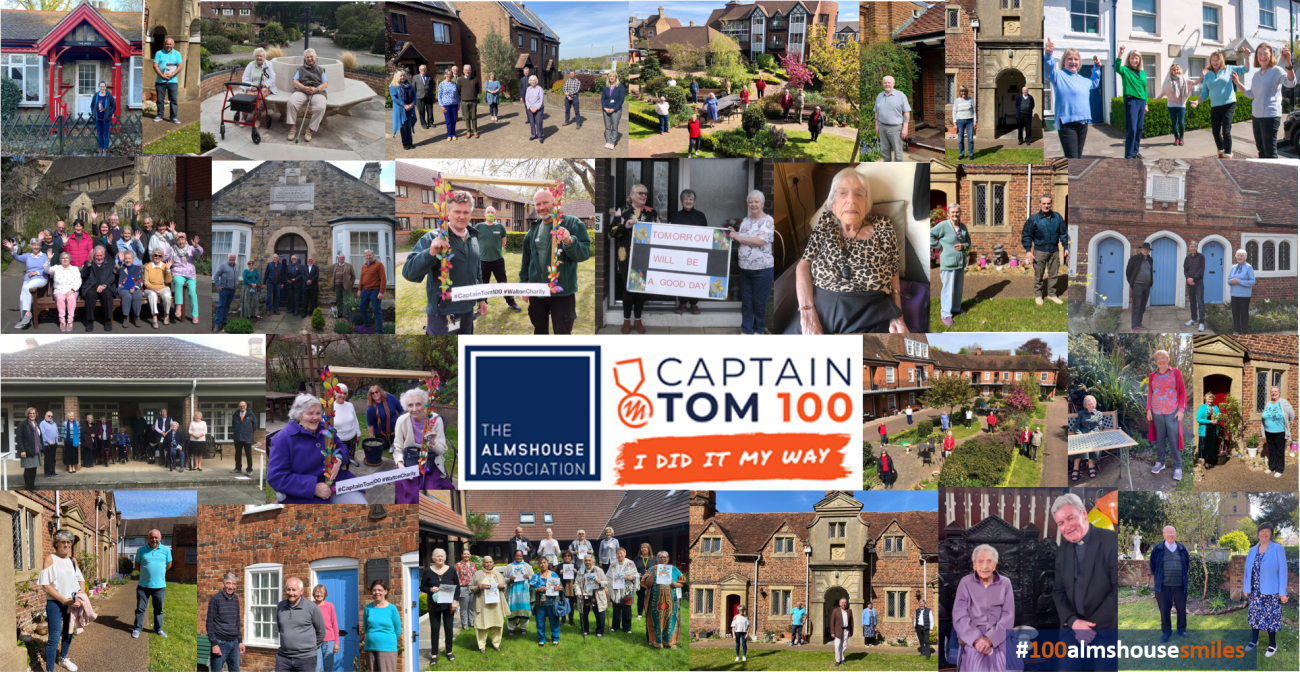
Last month, we asked our members to join us with the national campaign as part of an initiative by The Captain Tom Foundation. Our contribution had the aim of raising awareness of our unique form of affordable social housing which has at its heart one of Captain Tom’s key legacies – combating loneliness.
To rise to the 100 Challenge, The Almshouse Association asked members throughout the UK to showcase their work by sharing a photo of trustees, staff and residents outside their almshouses with their biggest smiles!
We are delighted to report that we received a beautiful collection of smiles.
We even received smiles from contractors who are busy building the next generation of almshouses ! And photos are still coming in thick and fast
If you follow us on social media, you will have already seen the happy faces popping up on your phones, pcs and tablets and we will also be showcasing them on our website and in our Almshouses Gazette. Photos are still coming in and we will keep on posting them up for everyone to enjoy!
This huge effort has not only enabled us to celebrate the wonderful work our members do and how happy almshouse residents are across the country, but raised awareness of the almshouse movement as a whole.
An enormous ‘thank you and well done!’ to everyone who took part!
And more smiles! 🙂

The Almshouse Association held a meeting today (April 26th) with our local Member of Parliament, Theresa May MP, to discuss issues affecting the almshouse movement and how the Association is looking to tackle them.
We discussed the issue of recognition of almshouses from central and local government, as well as the wider public. We also talked about the potential for new almshouse development being held back due to this lack of recognition.
We were glad to see that Mrs May was well aware and an active supporter of her local almshouses in her Maidenhead constituency.
The Almshouse Association would like to thank Mrs May for taking the time to attend the meeting.
Posted 26 April 2021
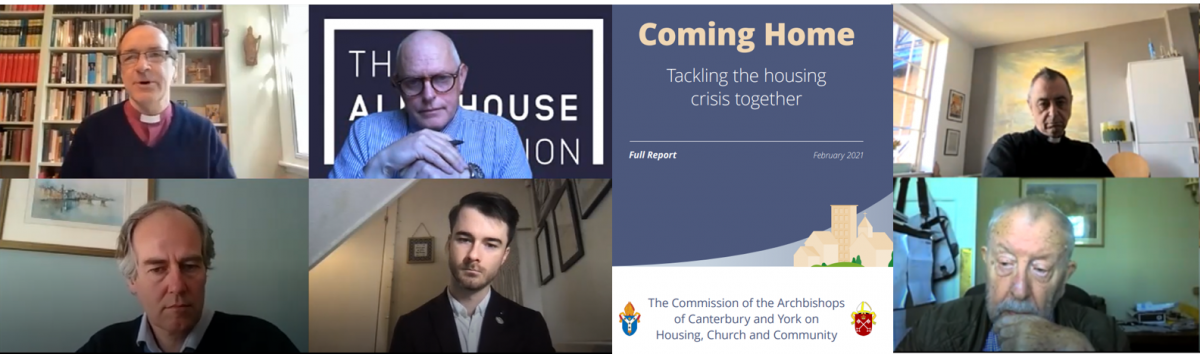
The Almshouse Association hosts webinar on Church of England Coming Home Report
The Almshouse Association hosted a webinar on the recently published Coming Home report from the Archbishop of Canterbury’s Housing Commission. The report made one of the most public and high-profile endorsements for the almshouse model in recent times.
The webinar represents the Association’s determination to see the report’s recommendations put into action by bringing together representatives of the almshouse movement and the Church. The discussion proved very useful in helping to scope out what the future relationship between both sides might look like and to plan next steps.
The Almshouse Association looks forward to further engagement between the Church and those now entrusted with enabling the report’s recommendations. We believe that we have a strong foundation due to the historic bond between almshouses and churches across the country.
We would like to say thank you to all those who attended and participated in the event, with a special thank you to our guest speakers: Bishop Graham Tomlin, Revd Jeremy Fraser, Nick Pollock and Michael Siggs.
A full recording of the webinar can be viewed here.
Posted 22 April 21

Eventide Homes resident May turned 100 last November. Due to coronavirus restrictions, the big party planned could not take place, but the charity organised for a Malus Floribundu tree to be planted in her honour to mark her milestone birthday.
They also put together a wonderful newsletter with photos and a potted history of how May came to Edgecombe Gardens which can be found by clicking here.
Unfortunately May contracted coronavirus just before her birthday and had a stint in hospital, but the amazing lady that she is, May made it out of hospital in time to celebrate her birthday at home and was able to smile through the window and show everyone her card from the Queen !
Photos and newsletter have been kindly sent in and published with the permission of resident May and clerk of Eventide Homes Joe Waters who is also The Almshouse Association Regional Representative for almshouse charities in Dorset, Hampshire and the Isle of White.
If you have a wonderful story about an almshouse resident, charity or trustee that you would like us to publish, please send in to karenmorris@almshouses.org.
Posted April 21
It is with great sadness that we have learned of the death of His Royal Highness The Duke of Edinburgh.
I know our members, many who have such strong connections to the Royal Family, will share our mourning and reflection. Our thoughts and condolences are with The Queen, our Patron His Royal Highness The Prince of Wales and the Royal Family.

We so often hear about the “housing crisis” as if it is a given fact. I was walking with a friend the other day and we were discussing a large housing estate that has had popped up on the horizon. “Well he said,…. we do need more houses – there is a housing crisis after all!” I looked at the group of very smart – no doubt ‘executive’ 4 or 5 bedroom houses and wondered what bit of the housing crisis these were addressing! I doubt it’s the affordable housing crisis for single and older people.
The Chartered Institute of Housing found that 280,000 social rent homes have been sold, converted to higher rents or demolished since April 2012, while just 70,000 new social rent homes have been built*.
I know it must be right and fair to help young people own their own homes as this prevents the rent trap that many are facing, but there still needs to be a proper affordable rental option offering decent, community driven homes, where people who are unable to buy can remain and have a good home in their communities.
It is clear that many affordable homes are sold or partially sold under Right to Buy, which accounted for the loss of 120,000 council homes, but how will we build our stock of decent affordable homes for the future if they continue to be sold?
I believe there is room for a wider variety of almshouses reflecting today’s younger people in housing need, helping them stay and work in their communities. Why almhouses? They are charities run by local trustees for local people in housing need and importantly they are exempt from the Right to Buy. These could provide an accessible option for young families or even intergenerational living. The almshouse model, although over 1,000 years old, has always been adaptable and can provide life changing opportunities to communities across the country,
Let’s tell it how it is … there is a housing crisis but it is very much an affordable housing crisis and no amount of new executive homes on the open market will change that.
Nick Phillips CEO | The Almshouse Association
*Source: Insider Housing publication 29 Mar 21
Nick Phillips CEO Linkedin
Posted 30 Mar 21
The CEO of The Almshouse Association welcomes the recent report published by the APPG on Loneliness.
“From our research and that of others it is clear that everyone needs a warm and safe home, but more than that they need a friend and something to do that engenders pride. Almshouses are a 1,000 year old housing model that takes neighbourliness to its heart.”
Nick Phillips, CEO The Almshouse Association
It seems from both this recent independent review and other reports that we have come to recognise loneliness as a debilitating factor. It is this aspect that was highlighted in the almshouse study undertaken by the Whiteley Foundation for Ageing Well that suggested that small scale communities can help people live longer. It seems that the forefathers of today’s almshouse movement had this in mind and although an ancient model of housing its strength is often put down to the fact that the design and spirit of almshouses encourages, promotes and enhances neighbourliness.
The almshouse movement provides homes to over 36,000 people, but more are needed as there are not enough to satisfy the high demand not just for low cost homes in the community but for the added value of small scale community run housing.
Nick Phillips goes on to say “Almshouses are built with compassion and supported with companionship. Whilst they can be considered as a small provider in the UK’s housing world that are available specifically to those in housing need, they make a vital contribution to the affordable housing stock in Britain and it is heart-warming to hear the great bonds of friendships that develop around the courtyards and gardens of Britain’s almshouses. We are working hard to ensure that more almshouses continue to be provided for those in housing need”.
Posted 25 March 21
The Almshouse Association welcomes the inclusion of comments in Church Times from CEO Nick Phillips following the publication of the Church of England’s Coming Home report.
The report marks the most significant public support for almshouses in many years and should be viewed as a call to action for the Church and the wider almshouse movement. We believe that, used effectively, the relationship between the Church and the almshouse movement can lead to a new era of almshouses throughout the country.
You can read the full article here
Posted 1 March 21

Almshouse Association takes part in Housing LIN’s HAPPI Hour on Almshouses
The Almshouse Association was pleased to take part in a lively discussion on almshouses at an event hosted by Housing LIN.
The event, The future role for Almshouses in shaping local communities, also saw contributions from Almshouse Association members, architects and researcher Allison Pooley who helped to write the recent RICs report on almshouses.
We were proud to see such a vibrant conversation from both panellists and the audience, clearly showing the level of interest that almshouses can garner. There was clearly so much interest in the development of the almshouse model that we ran out of time. I am sure we will have an opportunity to revisit the discussion in the future but do let us know of any specific area of interest.
In the meantime, please do watch the session here if you were unable to participate.
Posted 1 Feb 21