The Almshouse Association regularly posts a news summary of the latest Policy and Governance legislation that could impact/requires action from member charities, with links to further information where applicable.
Our latest update can be found below and previous updates are listed at the bottom of the page.
GOVERNMENT
- £15 million government funding for garden communities – The Government has announced £15m in funding to support the growth of garden communities across England. The funding is part of a wider £69m programme to deliver 16,000 homes per year from 2025. The funding is targeted at 43 towns and villages across England who are listed as Garden Towns or Villages. A full list of the chosen areas can be found here.
Almshouses are uniquely placed to operate in these settings. As such, members operating in these areas and looking to further develop their provision may wish to get in touch with their local council to see how they can contribute to these communities.
- Government announces further support to help with cost of living – Chancellor Rishi Sunak has outlined further support from the government to help with the cost of living.
The key announcements were as follows:- The previously announced £200 loan for energy bills has now been raised to £400 and will now not need to be repaid.
- Two lump sum payments totalling £650 will be paid to 8 million of those on means tested benefits (see list below). The two payments will made from July and in the Autumn.
- Universal Credit
- Income-based Jobseekers Allowance
- Income-related Employment and Support Allowance
- Income Support
- Working Tax Credit
- Child Tax Credit
- Pension Credit.
- 8 million pensioner households, who receive winter fuel payments, will receive a one-off payment of £300.
- 6 million people who receive non-means tested disability benefits will receive a one-off payment of £150.
It was also outlined that, subject to review, benefits next year will increase by this year’s CPI. Local authorities providing support through the household support fund, or discretionary housing payments, will have funding extended by £500m from October.
The Almshouse Association welcomes the additional support at this difficult time. However, we are disappointed that there has not been any further clarification for members who operate communal heating systems. We intend to write to the Chancellor and other ministers to outline our concerns and continue to call for greater support for these members who are already facing an extraordinary rise in the cost of energy. All information regarding the announcement can be found here.
DIGITAL AND COMMUNICATIONS
- Update on Digital Switchover – In our most recent Almshouses Gazette we featured an article from Panel of Consultants member Careline365 (previously Lifeline24) regarding the need for members to take action ahead of the digital switchover in 2025.
Since that article was published there has been an update on the switchover which members should be aware of:
- BT has changed how they will approach the switchover, but have not pushed the completion date back, it is still currently set for 2025
- The rollout will continue, the difference now is that people who are unsure on the switch will have the option to opt out if they feel unready, however, everyone will still need to switch over eventually
- Almshouses are still advised to plan ahead and replace old analogue systems with up-to-date digital alarms, especially right now as the issues highlighted, that prompted the update, arises from old analogue technology being used on the new digital network.
Members with further queries can get in touch with Carline365 via Mark Law 01603 964306, keyaccounts@careline.co.uk
- Support with costs of TV licence – TV Licensing have provided a reminder of the support available for people who may be struggling to pay for their TV licence. There are a range of payment plans available to help customers to spread the cost of a TV licence, these include monthly or quarterly direct debits, or a TV Licensing payment card (which enables customers to pay weekly, fortnightly or monthly online, via text or call, on the TVL Pay app, or at any PayPoint outlet).
A reminder of the concessions available and how to apply for these can be found on their website along with a wide range of FAQs.
SEE ALSO: Training: ARC TV Licences | (almshouses.org)
WALES
- Final coronavirus restrictions removed – The Welsh Government is removing the final coronavirus regulations as of May 30th. This means From Monday 30 May, the legal requirement to wear a face covering in health and care settings will end. Full announcement details can be found here.
RECORD OF PREVIOUS 2021/22 Policy and Governance updates:
posted 30 May 22

15th June 22 – Join us for the biggest networking event of the almshouse calendar!
The Almshouse Association is very pleased to announce that The Almshouse Association 2022 Members Day will take place on Wednesday 15th June 2022 at the Grand Station in Wolverhampton.
- Special Guest Speakers and Panel experts including Richard Morrice (Historic England), Roland Karthaus (Architecture Matters), Tim Rutherford (Stone King LLP), Lisa Watson-Cook (Lester Aldridge), Adrian Nisbet (Argonaut HR), Diane Rutter (Charity Facilitator and Trainer), Sean Stafford (ACL) and Tim Richardson (Quinquennial Inspections).
- Workshops on Governing Documents, Green Energy, Attracting New Trustees, Mediation and Dealing with Challenging Residents.
- The Almshouse Association Awards – presenting to recipients of The Almshouse Association’s Patrons Award, The Almshouse Association Award for Excellence and Inspiration and The Gardens and People Award.
- Networking.
- Q & A with Panel of Experts.
- Exhibition stands include The Charity Bank, Higos Insurance Services Ltd, Ecclesiastical Insurance Group, Harrison Clark Rickerby’s solicitors, CCLA Investment Management, Moore Barlow LLP, Waverton Investment Management, Grout Insurance Brokers, Argonaut-HR and Fifield Glyn chartered surveyors.
- Refreshments and lunch
For more information and to book your place, please click here to download our booking form.
Come and discuss the almshouse movement, its past and future!
The Almshouse Association Members Day 2022 is sponsored by Higos in association with Ecclesiastical Insurance.

Free Training: Accommodation for Residential Care TV Licences
TV Licensing has recently provided training for almshouse trustees on accessing the Accommodation for Residential Care (ARC) TV License. This came after a number of members had experienced difficulties in accessing the licence for their residents.
TV Licensing provides the following guidance on ARC TV licence eligibility:
“These concessionary licences apply to:
– Care/nursing homes – registered with the CQC or Care Inspectorate in Scotland.
– Sheltered accommodation/supported living.
– Almshouses.
The licence enables those living there to pay a flat £7.50 a year for their licence. To qualify they need to be aged over 60 (and either retired or working less than 15 hours a month) or be registered disabled. The presentation is roughly 15 minutes long, if you have any follow up questions please do contact Dan Cooper at the details provided on the presentation.
The Almshouse Association took them up on their offer and following the successful training session we have been provided with resources which should help members with this process. The slides provide an overview of eligibility as well as making applications and renewals. It is specifically tailored to almshouses and so should prove a useful resource for all those handling ARC licences.
Our thanks to Dan Cooper, Senior Communications Specialist at TV Licensing for sending us the presentation. He is also happy to be contacted at daniel.cooper@bbc.co.uk in case anyone has any questions or would like to book a training session.
- The slides can be found here.
- Video link can be found here
posted 16 May 22
Chancellor Rishi Sunak has outlined further support from the government to help with the cost of living.
The key announcements were:
- The previously announced £200 loan for energy bills has now been raised to £400 and will not now need to be repaid.
- Two lump sum payments totalling £650 will be paid to 8 million of those on means tested benefits (see list below). The two payments will made from July and in the Autumn.
- Universal Credit
- Income-based Jobseekers Allowance
- Income-related Employment and Support Allowance
- Income Support
- Working Tax Credit
- Child Tax Credit
- Pension Credit
- 8 million pensioner households, who receive winter fuel payments, will receive a one-off payment of £300
- 6 million people who receive non-means tested disability benefits will receive a one-off payment of £150
It was also outlined that, subject to review, benefits next year will increase by this year’s CPI.
Local authorities providing support through the household support fund, or discretionary housing payments, will have funding extended by £500m from October.
The Almshouse Association welcomes the additional support at this difficult time. We are, however, disappointed that there has not been any further clarification for members who operate communal heating systems. We intend to write to the Chancellor and other minister to outline our concerns and continue to call for greater support for these members who are already facing an extraordinary rise in the cost of energy.
All information regarding the announcement can be found here.
posted 26 May 22
The Almshouse Association regularly posts a news summary of the latest Policy and Governance legislation that could impact/requires action from member charities, with links to further information where applicable.
Our latest update can be found below and previous updates are listed at the bottom of the page.
GOVERNMENT
- Home Office opens consultation on Emergency Evacuation Information Sharing – The Home Office has opened a consultation regarding emergency information sharing within multi-occupancy housing, particularly for those with limited mobility.
This follows an earlier consultation on Personal Emergency Evacuation Plans (PEEPs), which the Government responded to here.
Members may wish to view the consultation and respond if they feel necessary. The Almshouse Association is happy to help members by responding on their behalf. Please contact Jack Baldan via jackbaldan@almshouses.org with any evidence you would like to submit.
- Fire Safety Act 2021 comes into force – On May 16th the Fire Safety Act 2021 was implemented. Implementation leads to the Fire Safety (England) regulations 2022 which have been laid before Parliament and will take effect from 23rd January 2023. Most of the new regulations only apply to high-rise residential buildings, however, regulations on fire doors and fire safety instructions will apply to all residential buildings with two or more domestic dwellings, regardless of the height of the building.
The Government has published a number of resources to help implement the new regulations, which can be found here:
For most almshouses the most important points to note are that the responsible persons will be required to:
- provide Fire Safety Instructions: relevant fire safety instructions should be made available to residents, which will include instructions on how to report a fire and any other instruction which sets out what a resident must do once a fire has occurred, based on the evacuation strategy for the building
- provide Fire Door Information: residents should be given information relating to the importance of fire doors in fire safety.
The regulations apply to England only. Information does not need to be shared until 23rd January 2023, in the meantime, members should look to work towards compliance.
RECORD OF PREVIOUS 2021/22 Policy and Governance updates:
posted 23 May 22
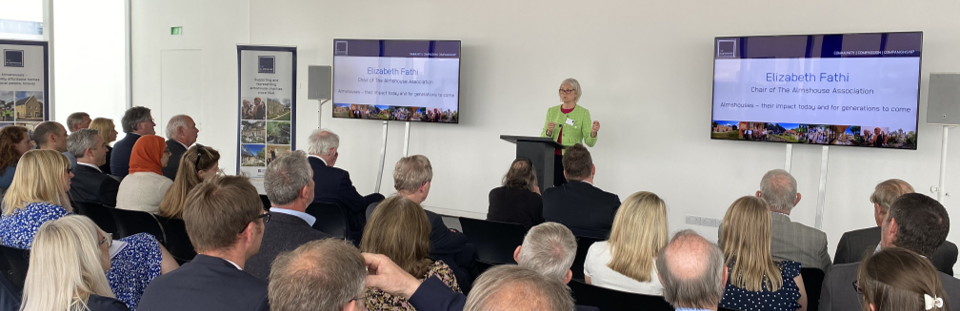
The Almshouse Association held a special event at the Tate Modern gallery in London on May 12th 2022 to further raise the profile of the almshouse movement.
A senior and influential group of individuals from the worlds of politics, housing, and business met at the Tate Modern. The aim of the event was to discuss the history of the almshouses and the contribution they make to society today as well as looking to the future provision of this valuable housing model. We heard a talk on the history of almshouses and their unique status from BBC historian, Dan Cruickshank. Further speakers included Almshouse Association Chief Executive and Chair, Nick Phillips and Liz Fathi, respectively. We also heard from United St. Saviour’s Chief Executive, Martyn Craddock on the work of the charity and future development plans. There was a very special contribution from almshouse resident, Nigel, who stole the show with his impactful story of how his home had helped him stay sober and rebuild his life.
Guests were also treated to tour of Hopton’s Almshouses; with the gardens in full splendour and the backdrop of high-rise buildings, these small and perfectly formed homes never cease to captivate the audience!
We were pleased to see a full house in attendance, showing the genuine intrigue and desire to learn more about the enduring form of community housing. This forms part of the Association’s key objective to protect and promote almshouses so that they may be better understood by those outside of the movement. In turn we hope this will lead to the creation of new almshouse charities and greater support for those already established.
Our members will be aware that as a movement we face a number of challenges in the years ahead including net zero obligations and trustee recruitment. Events such as these will help spread the almshouse message beyond our comfort zone and bring new ideas and experiences into the movement. This will ensure that the almshouse model can endure and flourish for another 1,000 years to come!
The Almshouse Association regularly posts a news summary of the latest Policy and Governance legislation that could impact/requires action from member charities, with links to further information where applicable.
Our latest update can be found below and previous updates are listed at the bottom of the page.
GOVERNMENT
- Department of Work and Pensions to restart transition to Universal Credit – DWP has restarted its programme to move all households onto Universal Credit from legacy benefits and tax credits. This could impact the income of almshouse residents.
Some customers will ‘naturally’ move to Universal Credit as a result of a change in their circumstances while others will move through ‘managed’ and ‘voluntary’ migration. The DWP will also gradually increase invitations for legacy claimants to make the move onto Universal Credit. Claimants who make the move via the managed migration track will be provided with transitional protections. This means their income will be topped up if moving to Universal Credit leaves them with less money than they received previously. Those who opt to move voluntarily, however, will not receive these protections.
Guidance on moving to Universal Credit can be found here. It is recommended that anyone thinking of switching should consult an independent benefits calculator to check they will not be worse off by switching.
- Queen’s Speech – The Queen’s Speech took place on May 10th with Almshouse Association Patron, HRH The Prince of Wales, reading the speech in place of HRH The Queen. In total, 38 Bills were included in the speech, these included:
- Levelling Up and Regeneration Bill
- Creating a duty on the Government to produce an annual report tracking progress of the levelling up missions
- Laying the foundations for greater English devolution
- Improvements to the planning system, prioritising environmental assessments
- A locally set non-negotiable infrastructure levy
- Simplification and standardisation of local plans process.
- Renters’ Reform Bill
- Abolishment of section 21 of the Housing Act 1988 – the so-called ‘no-fault’ evictions
- Application of the Decent Homes Standard to the private rented sector
- New private landlord’s ombudsman and a property portal for landlords.
- Social Housing Regulation Bill
- Strengthening the role and powers of the Regulator for Social Housing
- Introducing greater transparency for tenants on landlord performance
- Strengthening of the economic regulation of the social housing sector to increase protection and investment
- Creation of new Tenant Satisfaction Measures.
- Wider Housing Reform
- Commitment to improve home ownership
- Commitment to creating a fair and just housing system, on top of the announced social housing reform Bill
- Promise to publish guidance for enforcement officers and consumers for the implementation of the Leasehold Reform (Ground Rent) Act, which was passed last session
- Cooperation with the Competition and Markets Authority in their ongoing investigation into mis-selling and unfair terms in the leasehold sector
- Commitments to further reform the leasehold and commonhold sector.
- Data Reform Bill – replacing UK GDPR
- Creating a data protection framework that is focused on privacy outcomes
- Greater action against organisations who breach data rights
- Simplify the rules around research
- It is also believed that the legislation could remove the requirement for cookie consent banners.
The Almshouse Association will, as always, monitor legislation as it develops for any unintended consequences which may negatively impact members if unaddressed.
WALES
- Welsh Housing Quality Standard 2023 – The Welsh Government has opened a consultation on the Welsh Housing Quality Standard. The standard currently applies to housing operated by Local Authorities and Registered Social Landlords. Most, if not all, Welsh almshouse charities are likely to not fit into this category, nonetheless, charities may wish to contribute to the consultation or make contact with The Almshouse Association who can reply on their behalf.
The consultation will run for 12 weeks as of May 11th and can be found here.
RECORD OF PREVIOUS 2021/22 Policy and Governance updates:
posted 16 May 22
The Almshouse Association regularly posts a news summary of the latest Policy and Governance legislation that could impact/requires action from member charities, with links to further information where applicable.
Our latest update can be found below and previous updates are listed at the end of the page.
New coding to specifically highlight almshouses!
The Charity Commission has been reviewing how it classifies charities’ operations so that it can better understand and analyse the charity sector.
Under the proposed changes, almshouses would be specifically noted alongside a member’s operations. This does not materially change how the charity operates or interacts with the Charity Commission, but marks improved recognition of the model as a distinct tenure in housing.
Information on the changes can be found here.
Department for Levelling Up, Housing and Communities
- Housing Ombudsman Call for Evidence on Noise Complaints – The Housing Ombudsman has launched a call for evidence to support its next systemic investigation which will look at noise complaints. The investigation will explore how social landlords manage reports of noise nuisance and what drives complaints about how these are handled.
The surveys close on 13 May 2022.
The Charity Commission
- Implementation Timetable for Charities Act 2022 – The Department for Digital, Culture, Media and Sport have announced when they will implement changes brought in as part of the Charities Act 2022. Changes will begin to be made from Autumn 2022 until Autumn 2023.
Miscellaneous
- Inside Housing Awards Nominations – Housing trade magazine, Inside Housing, has opened nominations for their Development Awards. There are a number of award categories almshouse charities could apply for, including:
- Best older people’s housing development
- Climate change retrofit project of the year
- Best regeneration project
- Best affordable housing development
- Best healthy homes development
It would be fantastic to see some of our members receiving national recognition for their incredible work!
Nominations must be submitted by midnight on May 12th. More details can be found here.
- Research Opportunity – The Dunhill Medical Trust are supporting a project led by Housing LIN and TSA as part of the latter’s TAPPI Phase 2 project. The project “seeks to co-produce a ‘TAPPI Framework’ by working with four locality ‘testbeds’ (or demonstrator sites), led by community-based organisations…This phase will gather the evidence of what is possible and challenge what is perceived to be impossible, building upon the learning gathered during the pandemic and creating new and scalable housing service models using technology-enabled care which supports personalisation and, simply, delivers better outcomes for people.”
As part of the project, a call has been put out for community-based organisations who are already interested in integrating technology with housing, health and social care and would be receptive to testing the TAPPI Principles, together with those that are new to the concept but recognise its importance. Those selected to act as ‘testbeds’ would receive £75,000 (inc. VAT) for resourcing and enabling technology solutions.
Members interested in taking part should read the bid guidelines and make an application here. Applications close on May 16th at 5pm.
The Almshouse Association is also supporting another Dunhill funded bid which is looking specifically at almshouses.
RECORD OF PREVIOUS 2021/22 Policy and Governance updates:
Posted 28 April 22
The Almshouse Association has recently held discussions with the Department for Business, Energy and Industrial Strategy on potential support for charities who wish to be more sustainable. As a result of these discussions, we are glad to report that almshouse charities can apply for the Workplace Charging Scheme.
What is the Workplace Charging Scheme?
The Workplace Charging Scheme is a government grant of up to £350 to support the provision of Electrical Vehicle (EV) charge points. The fund will cover up to 75% of the cost of buying and installing a charge point. The scheme was originally only available for select uses. However, after discussions with The Almshouse Association, it has been agreed that almshouse charities can apply for funding for any purpose, i.e. for residents or employees. There is also another scheme specifically for landlords which is open to organisations registered with Companies House or those VAT registered.
How can charities access the grants?
The grants are provided using the Workplace Charging Scheme. To access it, charities should:
If you run into any difficulties, please get in touch with Jack Baldan via jackbaldan@almshouses.org.
posted 28 April 22
The Almshouse Association regularly posts a news summary of the latest Policy and Governance legislation that could impact/requires action from member charities, with links to further information where applicable.
Our latest update can be found below and previous updates are listed at the end of the page.
Department for Levelling Up, Housing and Communities
- Draft Clauses Published on New Social Housing Regulation – New draft clauses have been published as part of changes to the regulation of social housing through the Regulator for Social Housing. A factsheet has also been produced on the role of the regulator and Housing Ombudsman Service. The Almshouse Association continues to monitor developments in this area. These changes will only affect members who are registered with the regulator.
The draft clauses can be found here.
The Factsheet can be found here.
- Failing Landlords to be ‘Named and Shamed’ Under New Regulations – Social landlords providing sub-standard housing and services would be publicly called out on the Government’s website and across social media channels.
This measure will only apply to almshouse charities who are registered with the Regulator for Social Housing and serves as a reminder to ensure that you are fulfilling all the requirements of registration. If in doubt, please do not hesitate to get in touch with The Almshouse Association so we can assist you before any issues are publicised.
The Government announcement can be found here.
- New Chair of the Regulator of Social Housing – Bernadette Conroy has been appointed as new Chair of the Regulator of Social Housing. The role of the Regulator is steadily becoming more central to the Government’s management of Registered Providers.
Details on the announcement can be found here.
The Charity Commission
- End of flexible guidance on meetings – On 21st April the flexible approach to charities holding meetings outside the terms of their governing documents will come to an end. Charities should check that their governing documents allow them to hold meetings in the way they wish. For example, you will need to ensure that your governing documents allow for online meetings if you have found these to be more convenient during the pandemic.
Charity Commission guidance for charities on coronavirus can be found here.
- New 5-minute Guides for Charity Trustees – The Commission has released several animated videos which bring its 5-minute guides to life. This includes new materials on safeguarding. The videos aim to fill in gaps in knowledge, especially for new trustees.
More details can be found here.
Employment Law
- Fear of catching COVID-19 not a protected belief rules employment tribunal – In a recent employment tribunal case it was concluded that an employee’s belief in a fear of catching Covid-19 and a need to protect herself and others, did not amount to a philosophical belief for the purposes of establishing a protected characteristic under section 10(2) Equality Act 2010.
Panel of Consultants member, Stone King has provided an overview of the ruling which can be found here.
Coronavirus
- Spring Booster Campaign Launches – The spring booster vaccination campaign commenced on March 21st. Those eligible for the booster include adults aged over 75, the immunosuppressed and, crucially, all residents in a care home for older adults. The Almshouse Association has always argued that almshouses should be treated in the same way as care homes due to their communal nature. Members should get in touch with their local authority or NHS group if their residents are struggling.
RECORD OF 2021/22 Policy and Governance updates:
Posted 4 April 22